
by Steve Cox
I’m finishing the draft of my third novel. So, you might think, I’ve got the hang of this writing game. That’s not how it feels.
Book one was an apprenticeship. A relaxed journey into an unknown land, casually picking up skills, ideas, tools and confidence about a new way of life.
I had, first, to learn how to tell a story. I was amazed, initially, that this isn’t an entirely innate thing, genetically passed down through the generations.
‘You mean I have to learn how to do it?’
That’s right. I learnt about short stories in an evening class, run by the marvellous Pam Fudge, a prolific local author. And I also read advice to children about how to tell a story. It’s simple. Anyone can do it. But it is a structure. It needs attention to some basic principles.
So, with some slim lessons packed into my haversack, I ventured into the land of my first novel. I didn’t know where I was going. I didn’t know how long the journey would be. I didn’t even know if I could do it. Until you’ve done it you don’t know, do you?
Apart from my storytelling primers I had an ‘idea’. The siege of Lyme Regis, in 1644. I visited the town in around 2000 and was gobsmacked that a little fishing town had withstood a Royalist army during the first English Civil War for two months – and come out on top. I mean, Lyme doesn’t have a castle. It isn’t fortified in any way. If you wanted to have a chance of resisting an army of 6-10 thousand men, you need something in your favour. Whereas, Lyme is small, at the bottom of a valley, with its main harbour a half-mile from the town and with only a line of houses around part of its margin. But they had one thing in their favour – the spirit of the people of Lyme and of the soldiers who defended it.
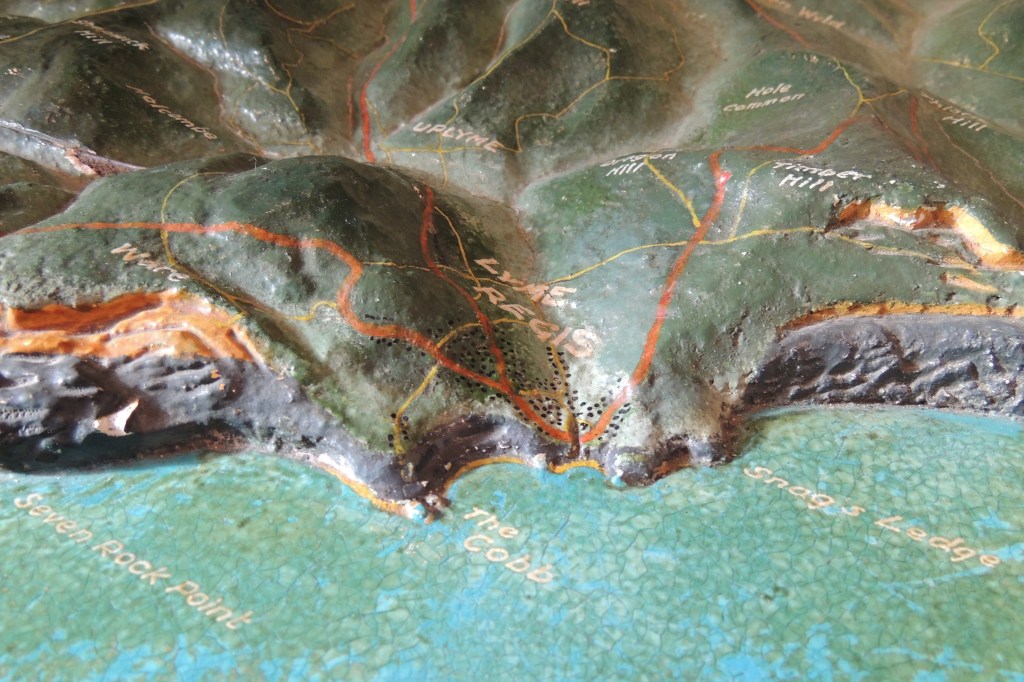
Once I’d heard the story, I felt this feat needed to be better known. I’ve always been interested in history – including the English Civil Wars, which I’d never fully understood – but I’d never come across this episode.
This experience propelled me into Pam Fudge’s evening class. From nowhere, I had a deep intentional desire to tell the story, a story of the siege and I knew I needed help. A lot of help.
With the lessons learned, I started on the task. The siege is a fact. But I realised that to tell a story about it, I needed strong, vivid characters to help the readers feel that they had been there.
And so, I started on the journey. I didn’t know if I’d be able to finish it. I only knew that I had enough passion to start. It didn’t take too long before I’d met the main protagonists. Tom Tyler, a young baker, callously kicked out of Poole when his father dies; Effra Bayly, a London thug who befriends Tom and carries with him deep secrets; and Bathsua Hooker, a young woman with a clear idea about right and wrong and a zeal to make a difference. It wasn’t until I’d written 50 thousand words that the realisation came that ‘I can finish the story,’ ‘I will finish the story.’
That apprenticeship that began in Pam Fudge’s class continued while I wrote. And, because I had a business to run, a career to forge, it was a part-time, self-taught course.
The course included learning about ideas of story structure and researching every way I could think of about life and politics in England in the 1640s.
And it took seventeen years!
It was a sweet moment when I first held a real, solid copy of As the Sparks Fly Upwards. But, the story doesn’t end there. There was a second book. ‘The difficult second novel’ as I’d heard it called. I thought I’d tackle this differently to the first one. I concentrated on Tom’s and Effra’s story as they get caught up in a calamitous campaign by the Roundheads into Cornwall. Bathsua is left in Dorset in peril in some way and Tom has to get back to her pdq.
Only, Tom’s story felt a bit light. What if I beefed up Bathsua’s experience? I felt a bit embarrassed about using her as a damsel in distress without much she could do about things. As I thought about this, her story blossomed into one at least as significant and dramatic as Tom’s. Crikey! I never saw that coming.
So, the task with book two, was to weave the two stories together. I wrote them separately – except for when they come together towards the end – then figured out how to toggle between the two. A Bag of Blood and Bones took four years and, in my opinion, is a better book than the first one.
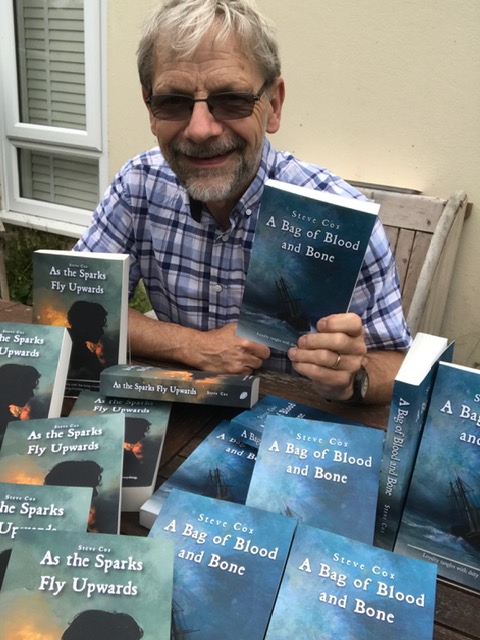
Book one – done. Book two – done. Book three, then, ought to be a doddle! ‘Aha,’ I said. ‘Now I know what I’m doing, I must make this one even better than the last.’
Book three is different. It weaves together three separate strands of story, from Tom, Bathsua and Effra, and moves the story from Dorset up to Newbury and then to London. It also slips in a couple more point-of-view characters that give a wider perspective than Tom, Effra and Bathsua have. And I’ve found the last part of this book really, really difficult. There are plot threads hanging out everywhere. I feel it’s like sewing together multiple jellies or wrestling underwater with a mad octopus. I’ll be glad when it’s finished.
I’ve jumped around with this book and written lots of the chapters out of chronological order. This is coming home to roost as I tie off all those loose ends in a fantastic finale. (Well, that’s what I think.)
I wonder what you will think?
Find out more about Steve here: https://www.stevecox.co.uk
 Author Events
Leave a comment