
by J. Patrick Armstrong
The best advice I ever received about my writing was from a much more illustrious Armstrong. I was working as a barman in Glasgow whilst limping over the finish line of my doctoral thesis on late twentieth-century American poetry. It was one of three concurrent jobs at the time. My funding had run out, so I was teaching English and Comparative literature to the university’s undergrads, driving a van and delivering frozen food to restaurants in Glasgow and Edinburgh, and pouring pints for the great, good and not-so good of Glasgow’s West End. The more illustrious Armstrong was Craig Armstrong, the musician and film composer who’d worked for the likes of Baz Luhrmann and Oliver Stone. In true starstruck fashion, whenever he came in, I always tried to serve him, in the hope of some Hollywood gossip and perhaps a pearl of wisdom or two about success. When I finally plucked up the courage to ask him about his work, and make that cringy move of telling him I was writing, he was polite, cordial and even asked me about my work, which at the time was a messy Glasgow noir/black comedy novel about a suicidal barber who was trying to have himself killed by a thug with a crisis of conscience. I can’t remember if I divulged these details to him. I hope not. But what I do remember was his pithy and simple advice – “Keep going. Whatever happens, just keep going.”
As ridiculous as it might seem, that simple piece of advice (which surely I could have told myself) became a kind of mantra. Armed thus, I applied it to my thesis and finished it, simultaneously applying it in the wee small hours of the morning to The Barber (as I’d taken to calling it) and finished that. My first novel complete, I experienced my first rush of that oddly private set of feelings: the debut novelist’s sense of achievement tinged with the rather anti-climactic question: “What do I do now?” Had there been an omniscient guiding voice present in my life (wouldn’t that be useful?), it might have said, with God-like gravitas, “Thicken thy skin, young(ish) man, for now comes the repetitive trial of the debut novelist: Rejection, Rejection, Rejection!”
Agents – those doyens and gatekeepers of the literary world, most of whom have not written a novel themselves, armed with their credentials, their bookish backdrops, their knowledge of everything before their time, their fascistic love for the borders of genre (and commission), their myriad ways of politely saying “No!” and (most admirably of all) their labelling of the hours of work and persistence (not theirs) of thousands of writers as ‘slush.’ I’m not bitter, honestly. The first agent to honour me with a request for the rest of The Barber told me that, while some of the writing was “superb” (Yes!), she felt polluted by it (Oh!), and I might be better served moving on to my next idea (really?). Time again for the mantra from the more illustrious Armstrong – “Just keep going!”
Mercifully, for me, there was a “next idea.” The Barber went into a drawer, where he still awaits the unearthing of his dark tale. By this time, I was in Taiwan, lecturing in English at a university in the small Town of Huwei. And in the early hours of the morning, before the challenge of teaching Hemingway and Shakespeare to Taiwanese ESL students, fuelled by coffee and steamed buns, I set to work on the story of a Christmas hit-and-run and the unravelling lives of the driver and a teenage witness. I remember the frenzy in which I wrote the climax, that feeling of knowing the ending and pushing the characters toward their fates, driven on by little more than the thrill of completion and, of course, the mantra, “keep going, just keep going,” my very own “Keep Calm and Carry On.”
This time around, I forked out for a professional editor through the Writers’ Workshop, who called my novel “a masterpiece of literary suspense” (his words, not mine) and told me he’d eat his report if the novel wasn’t picked up and published. Well, after that, it felt like literary stardom was within touching distance, and all I had to do was put the book out there and wait for the scramble of agents and publishers to begin. But alas, what actually transpired again was rejection upon rejection, here and there, a request for the rest and that spike of hope, followed again by rejection and the recourse to the mantra from the more illustrious Armstrong – “Whatever happens, just keep going!”
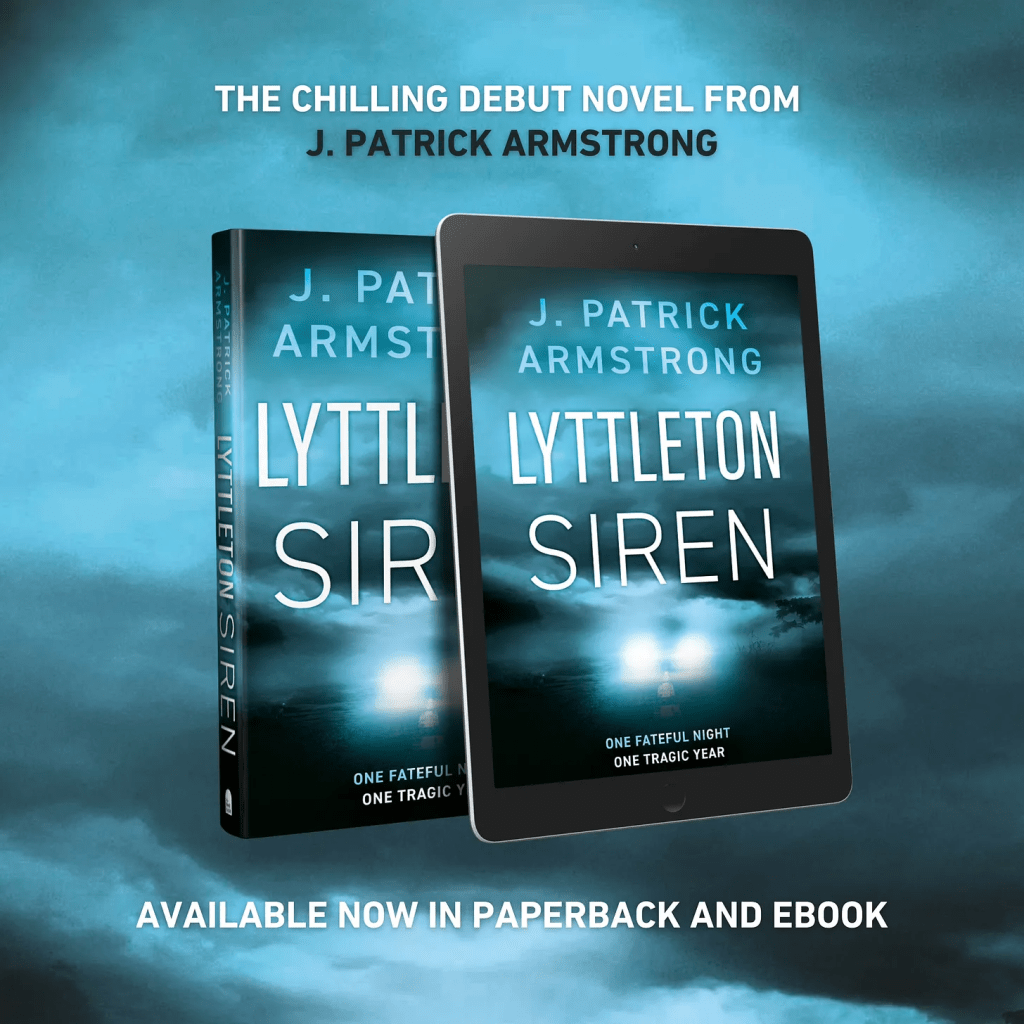
Lyttleton Siren had begun life as a two-hander: Melvyn and Kevin – a frustrated, middle-aged man and an afflicted teenage boy whose lives become tenuously connected through two dreadful incidents in their shared small community. While I was convinced by my characters and their story, the sobering notion that the book was thin kept tugging at my consciousness. That was the word that kept pricking me as I read over the pages and chapters, paring and adding, always aware that something significant was lacking, a kind of elephant that wasn’t in the room, so to speak. My “just keep going” mantra had taken me on to my next novel, a whole new speculative world in which to immerse myself. But I felt stubborn about Siren. It was better than The Barber (I thought), and it deserved more than being left in a drawer.
Inspiration can come from all kinds of places. Around that time, I happened to read a David Lynch interview in a weekend supplement, in which he said words to the effect of, “You can’t go looking for good ideas, but you need to notice them and catch them when they float by.” Oddly, this reassured me, and I cracked on with my next novel, placing my newfound Lynchian faith alongside the more illustrious Armstrong’s mantra, convinced that the thinness of Siren would be solved if I just kept going and stayed alert for that flash of inspiration.
When it came, it was more of a dawning of the obvious, and I chided myself for not having seen earlier the necessity for the voice of the bereaved mother. And once she was in my head, I could not have removed her even if I had wanted to. So I set about the task of working her into the novel, turning the parallel, masculine duet of Melvyn and Kevin into the more balanced, feminised triptych of Melvyn, Kevin and Lisa. As Lisa’s chapters were planned and written, the thinness that had kept me awake at night was fed and fattened, and Lyttleton Siren gained weight and felt more like the story I had set out to write.
Fast forward through the trials of COVID, and I found myself back home with my family, bruised and dented by two international moves, a career change, and the heartbreaking loss of my dad. Oddly (or not), the drive to get somewhere with my writing was still intact, a little tattered, like the insignia of a defeated army, but still there all the same, still accompanied by the faint echo of the more illustrious Armstrong’s advice, “Whatever happens, just keep going.”
This time, the mantra was applied to sending out the Siren and finishing the new novel. When The Book Guild offered a co-publishing deal, I had a big decision to make – keep plugging away at the traditional route or get the book out there and move on. Framed in this way, it wasn’t much of a decision at all. But me being me, I stewed over it anyway, until the voice of the more illustrious Armstrong kicked in, and “just keep going” became “feel the fear and do it anyway,” staying with me throughout the publishing process and trials and tribulations of social media and self-promotion.

It’s unlikely that I’ll be approached in the future for writing advice, and I would hope not to be so presumptuous as to offer it without being asked. But if I were, I would probably disappoint the asker with an answer deemed too simple. However, the one that has served me best and stood the test of time, the one I use around five a.m. every morning as the laptop winks on and the kettle boils, is the simplest and the only (stolen) one I have – “Just keep going.” After all, what else are you going to do?
For more or to follow J. Patrick Armstrong: https://jpatrickarmstrong.com https://www.instagram.com/j.patrickarmstrong
 Author Events
Leave a comment